
Are 3D gel number plates legal?
Yes — 3D gel number plates are road-legal in the UK, provided the plate meets British Standard BS AU 145e. GOV.UK's display rules say so in as many words: plates “can have 3D (raised) characters”. The gel finish isn't a legal grey area — what decides legality is everything around it: the colour of the characters, the font and sizes, the background and the markings. Here's the full picture, from a DVLA-registered supplier.
What a 3D gel plate actually is
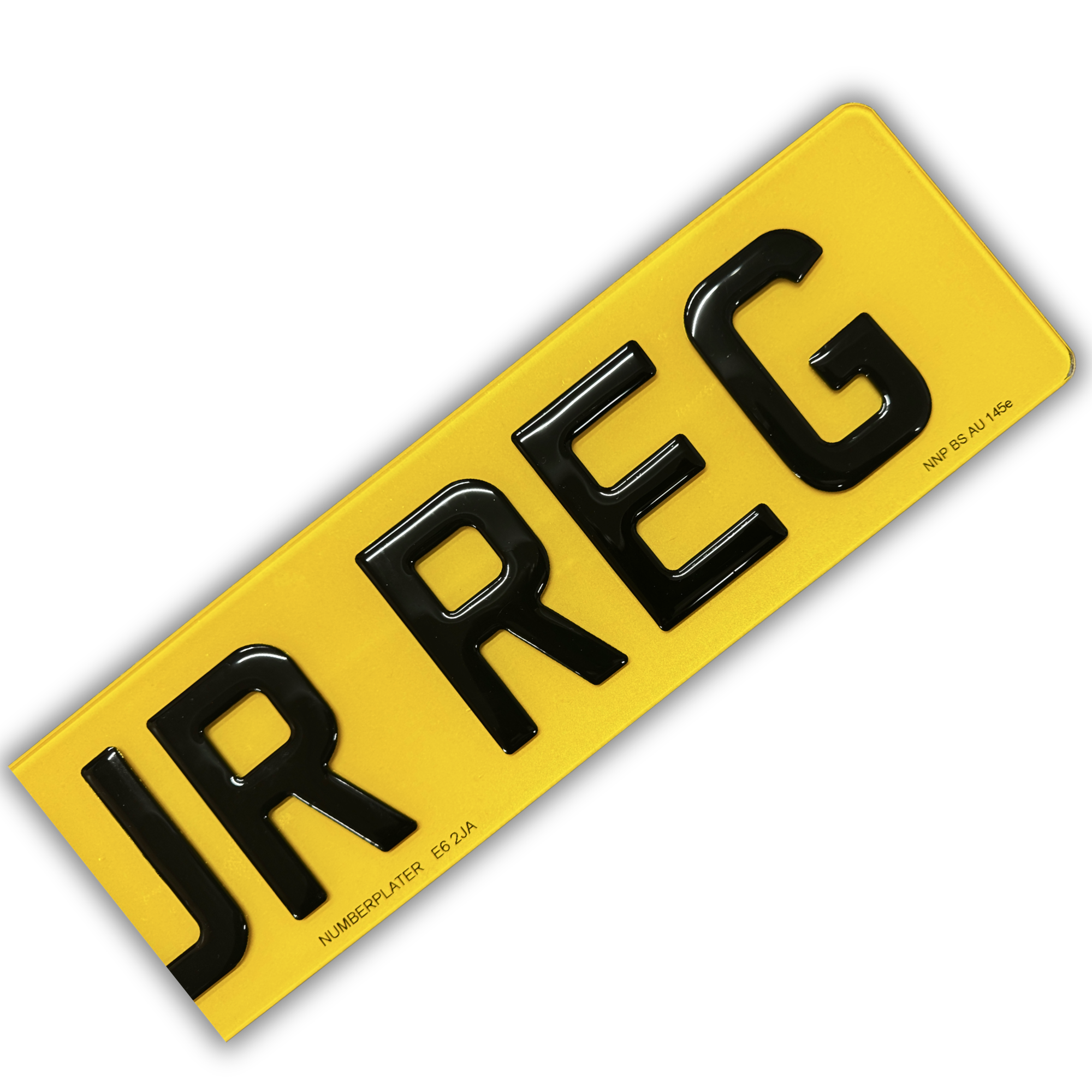
A 3D gel plate has characters formed from black gel resin, cured into a smooth raised dome and applied to the reflective plate face. Catch it in the light and each character has a soft, rounded profile — more depth than a flat printed plate, softer than the sharp edges of its thicker acrylic cousin, the 4D plate. Underneath the gel, everything else is a standard plate: the same reflective face, the same mandatory font, the same markings.
What the law says
Every plate fitted since 1 September 2021 must meet BS AU 145e. GOV.UK's display rules require a plate to:
- be made of reflective material — white background on the front, yellow on the rear;
- show characters in a single shade of black — and the same rules state plates can have 3D (raised) characters, which is precisely what a gel plate is;
- have no background pattern;
- be marked to show who supplied it, and carry the BS AU 145e marking;
- use the mandatory font at the prescribed sizes — for cars, characters 79mm tall and 50mm wide (except 1 and I) with a 14mm stroke, 11mm between characters and 33mm between the two groups. The full rule set is in our plate rules guide.
Note what's not in that list: any restriction on raised characters. The law regulates how a plate reads, not how much depth its characters have.
What makes a gel plate illegal
When a 3D gel plate is illegal, it's never the gel itself — it's one of these:
- Gel that isn't a single shade of black. Coloured gel, two-tone effects, tinted or “smoked” finishes all fail the single-shade-of-black rule. This is the most common way a gel plate goes wrong.
- Wrong font, size or spacing. The character style and dimensions are fixed. A stylised or squeezed gel character is illegal regardless of finish.
- Missing markings. A legal plate carries “BS AU 145e” and the supplier's details. Gel stick-on kits applied over an unmarked backing plate haven't been made to the standard.
- A patterned background — the background must be plain and reflective.
The penalty for an incorrectly displayed plate is blunt: a fine of up to £1,000, and the vehicle will fail its MOT.
The MOT position
Plates are checked at the MOT, and the test cares about the display rules, not the manufacturing technique. A BS AU 145e-compliant gel plate passes; a non-compliant plate of any kind fails. If a tester queries a compliant plate, the BS AU 145e marking and supplier details on the plate itself are the evidence it was made to the standard — which is one more reason never to buy an unmarked plate.
How to buy a gel plate that's genuinely legal
- Buy from a DVLA-registered supplier. It is illegal to supply number plates without being on the DVLA's Register of Number Plate Suppliers. We're No. 75456.
- Expect to be asked for documents. Registered suppliers must verify your entitlement to the registration and your identity before making a plate. A seller who skips this isn't following the rules.
- Check the plate: single shade of black, standard font and sizes, plain reflective background, and the BS AU 145e + supplier markings present.
- Wondering about 4D instead? Both finishes are equally legal when compliant — the differences are purely visual. See our 3D vs 4D comparison.
Quick answers
Are 3D gel number plates legal in the UK?
Yes. GOV.UK's display rules state plates can have 3D (raised) characters, so a gel plate is road-legal provided it meets BS AU 145e: characters in a single shade of black, the mandatory font and sizes, a plain reflective background, and the supplier and BS AU 145e markings on the plate.
Will a 3D gel plate pass an MOT?
A compliant gel plate passes. The MOT checks the display rules — colours, font, sizes, spacing, markings — not the manufacturing technique. A gel plate that breaks any of those rules fails, exactly as a flat printed plate would.
Are coloured or tinted gel characters legal?
No. The rules require characters in a single shade of black. Coloured, two-tone or 'smoked' gel finishes fail that requirement, and an incorrectly displayed plate risks a fine of up to £1,000 and an MOT failure.
What's the difference between 3D gel and 4D plates?
Both have raised characters and both are legal when BS AU 145e-compliant. 3D gel characters are domed and glossy, formed from gel resin; 4D characters are laser-cut from thicker solid acrylic with crisp flat tops. It's a difference in look, not legality.
Need a plate that's actually legal?
Build yours in our configurator — legal font, sizes and spacing are applied automatically, and every order is entitlement-verified before you're charged. If a combination isn't road-legal, it won't let you build it.
Build your plate →Related guides
Reviewed 2026-07-02 · Written by Numberplater Ltd, a DVLA-registered number plate supplier (RNPS No. 75456). This guide is general information, not legal advice — the rules summarised here are set out in full in DVLA guidance (leaflet INF104 and GOV.UK).